
Grayscale Pixel Art with Graphite Pencils: Explore Ancient Ruins One Square at a Time
A pencil can do much more than draw a line.
With pressure, layering, blending, and careful control, a simple graphite pencil can suggest light, shadow, depth, texture, and form.
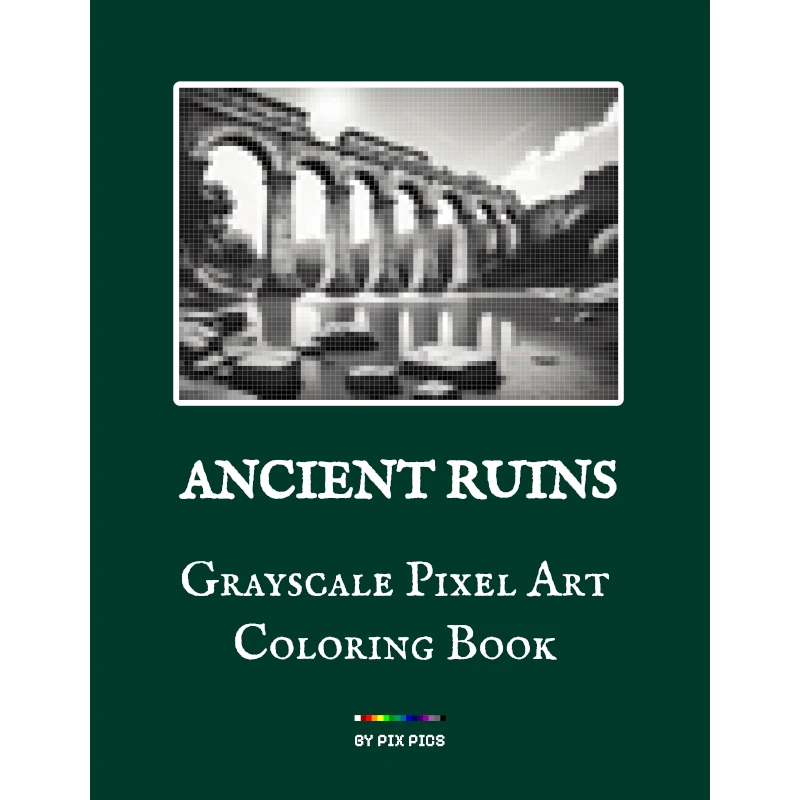
Grayscale Pixel Art Ancient Ruins Coloring Book
Ancient Ruins – Grayscale Pixel Art Coloring Book explores those possibilities through an unusual format: grayscale pixel art.
Instead of beginning with a blank page, you begin with a structured grid and a set of grayscale values.
As you work through the cells, an architectural scene gradually emerges.
A pyramid.
A castle.
A tower.
An ancient gate.
A bridge.
A cathedral.
What begins as a collection of small squares becomes a complete scene.

What This Book Offers
The book contains 50 hidden full-page grayscale designs inspired by architecture, ruins, monuments, and historic-looking structures.
The images are created using a detailed 3 mm grid, with 64 × 90 cells providing room for larger scenes.
Both portrait and landscape orientations are included.
The book uses a practical six-shade graphite palette, allowing you to create the designs with a standard set of graphite pencils.
Inside you’ll find:
- 50 unique grayscale pixel-art images
- Architectural and ancient-ruin themes
- Pyramids, castles, towers, bridges, gates, aqueducts, halls, cathedrals, and more
- 3 mm grid cells
- 64 × 90 cell fields
- Portrait and landscape compositions
- Grayscale guides for each image
- Six graphite pencil shades
- 8.5 × 11 inch pages

Why Grayscale Pixel Art Is Different
Color can make a picture immediately recognizable.
Grayscale removes that shortcut.
Instead, the eye begins paying attention to value.
- Which areas are light?
- Which are dark?
- Where is the strongest contrast?
- Where does one form overlap another?
These questions are fundamental to drawing.
The pixel grid adds another layer of structure. Rather than creating every line from scratch, you can concentrate on translating different grayscale values into graphite.
This makes the process both creative and methodical.
How to Use These Pages
- Begin with the grayscale guide for your chosen image.
- Identify the different shades and prepare your graphite pencils.
- Then work through the grid.
You can shade each cell according to its assigned value, keeping the pixel structure crisp and geometric.
Or, if you want to experiment, you can gently soften transitions, strengthen contours, and introduce additional tonal variation.
This creates an interesting choice:
Do you preserve the pixel aesthetic, or push the image toward a more traditional pencil drawing?
There is no single creative answer.

Craft Ideas and Project Tips
Practice tonal control
Try completing a design using very light pressure for the lighter values and progressively stronger pressure for darker ones.
Experiment with blending
Once a page is complete, experiment with carefully blending selected areas while leaving others crisp.
Compare the two approaches.
Study light and shadow
Look at the finished architectural scene and identify where the strongest light and darkest shadows appear.
This can help develop awareness of value relationships.
Explore architecture
The ancient and monumental structures provide opportunities to observe shapes, perspective, openings, columns, arches, walls, and other architectural forms.
Create a monochrome collection
Complete several pages and display them together.
The absence of color gives the finished collection a distinctive, almost vintage architectural-study appearance.

Final Thoughts
Grayscale coloring doesn’t have to mean simply filling areas with gray.
It can become an exploration of value, contrast, light, shadow, and form.
Ancient Ruins – Grayscale Pixel Art Coloring Book combines those ideas with the structure of pixel art and the visual drama of monumental architecture.
With 50 hidden images, 3 mm grids, and six graphite shades, every page gives you another opportunity to experiment.
You can follow the values carefully.
You can preserve the pixel aesthetic.
Or you can use the structured designs as a starting point for more expressive graphite work.
Choose a scene, sharpen your pencils, and start building the image one shade at a time.
Where to Buy This Book
Select a store and click the View button.